Why Montessori Parents Choose Natural Materials
April 10, 2026
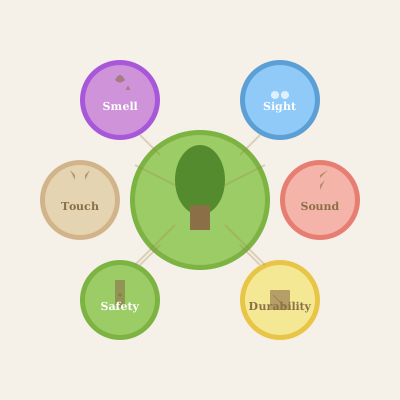
The Problem with Plastic
Walk into any toy store and you’ll be greeted by a wall of brightly colored plastic — flashing lights, electronic sounds, and batteries included. It’s dazzling for a moment, then forgettable.
Children’s brains are wired for novelty, but plastic toys often provide a shallow version of it: loud, stimulating, and over-engineered. Once the novelty fades, the toy becomes background noise.
Natural materials work differently.
What Natural Materials Offer
Sensory Richness
Wood has grain, warmth, and weight. Silk is cool and slippery. Beeswax is moldable and fragrant. These qualities engage children’s senses in complex, layered ways that no plastic can replicate.
When a child picks up a smooth wooden block, they’re receiving information about weight, temperature, texture, and density — all at once. This multi-sensory input is exactly what the developing brain craves.
Open-Ended Play
A set of wooden blocks can be a tower, a road, a house, a spaceship, a bridge. A battery-powered toy that makes one sound when you press one button offers nothing like this kind of imaginative flexibility.
Open-ended materials grow with the child. The same wooden shapes that fascinate a ten-month-old will be used in complex constructions by a four-year-old.
Longevity and Beauty
Well-made natural materials age beautifully. A set of quality wooden toys can last through multiple children and generations. They don’t fade, break in frustrating ways, or end up in a landfill after six months.
There’s also something about beauty that matters in the Montessori environment. A carefully made wooden puzzle, a soft linen play mat, a basket of river stones — these things invite care and attention in a way that a plastic toy doesn’t.
Practical Tips for Choosing Natural Materials
You don’t need to throw out everything and start over. Here’s how to begin:
- Audit your current toys — notice which ones your child actually uses, and which ones sit untouched
- Start with one basket — a treasure basket of natural objects is free and endlessly rich
- Choose natural versions of what your child loves — if they love sorting, find a beautiful wooden sorting tray
- Look second-hand — quality wooden toys are often available second-hand in beautiful condition
Natural Doesn’t Always Mean Montessori
A few caveats: not everything “natural” is automatically Montessori-aligned, and not all plastic toys are worthless. What matters is whether a material invites exploration, supports independence, and is developmentally appropriate.
Use your judgment and observation. Watch what your child actually gravitates toward — and let that guide you more than any shopping list.